India is a country in South Asia whose capital is New Delhi. Also called the Republic of India, in 2022, it was the second most populous country in the world, with 1.26 billion inhabitants. In addition, India is also the second largest tea-producing country in the world, renowned globally for its virtues.
India is a country that attracts more than 1.2 million tourists every year. It alone contains 17.5% of the world's population. India is a country that also has 29 states with 7 different territories. The population is relatively young since 45% are under 20 years old. The country has 7,000 kilometres of coastline and a 63,974 km railway network, which carries more than 14 million passengers across the country every day. There are 24 official languages, but in total, more than 1000 languages and dialects are spoken throughout the country, which makes it a very rich territory in terms of language and culture. The country has an area of 3287263 km².
In
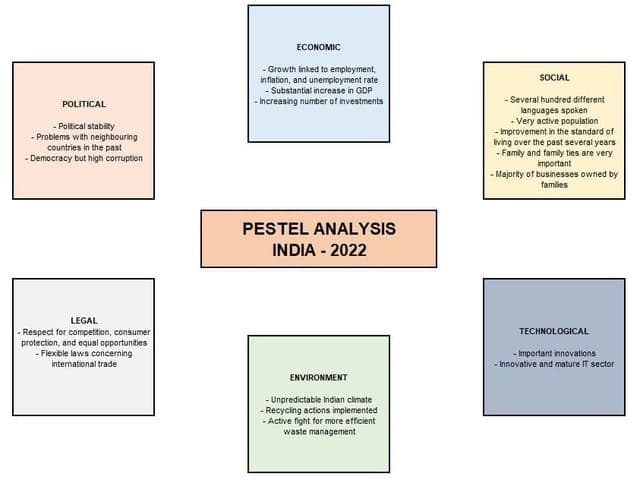
this analysis, we will study the PESTEL analysis of the country. This matrix
makes it possible to better understand the environment of the country through
various characteristics, such as politics, economy, sociology, technology,
ecology but also everything related to the legal field. This strategic analysis
is put in place to identify the strengths and weaknesses of a territory and also
the opportunities available to it for the years to come. It also makes it
possible to highlight the growth of the country and its various sectors of
activity, in order to know how it is possible to attract investors over the
long term and allow better development for the whole country.
Political
Political
stability is one of the essential characteristics for the country to establish
lasting contacts with other countries from a commercial point of view. India
has political stability, which is an advantage for existing companies but also
for those wishing to position themselves in the country in the years to come.
The political domain is important for the capital market because, despite this
newfound stability, India has gone through some turbulence in the past due in
particular problems with neighbouring countries. The political world is
influenced by individual interests as well as by religion. Note also that India
is a country with democracy, but beware because corruption is very high in some
areas. This can affect economic growth over the long term. Gradually, companies
are becoming more independent, so their development is more established, and
every year many companies want to diversify by also being based in this country
in order to generate additional market share.
Economic
From
an economic point of view, it is a question of determining whether the
companies present in the country, as well as those wishing to enter it, can
achieve their quantified objectives, and this, in a sustainable manner. It is a
question of not only growth because this growth is linked to employment,
inflation, and also the current unemployment rate. All this encourages or discourages
companies from establishing themselves in the country. It is in India's
interest for companies to be able to relocate part of their production within
the territory in order to generate more employment and thus contribute to
economic growth. India has seen a substantial increase in its GDP, which has
led to the development of some rather attractive opportunities for foreign
companies. In addition, the number of investments has also increased, which
makes it possible to stimulate the whole activity of the country. The
infrastructures are better distributed and more modern in order to encourage
foreigners to come and settle in the country.
Socio-cultural
This section is about everything that concerns consumers, their buying habits, and the way they perceive consumption. When a company decides to set up in another country, it must know the buying habits as well as the behaviour of consumers because this largely determines what marketing strategy it will have to put forward in order to be able to develop. Cultural habits are also very important, as are beliefs, values, and major health concerns. In addition, it is also necessary to know how the employees of the country in question position themselves in relation to the professional world, as this may be radically different to other countries.
India
is considered a territory that is diverse in all areas. We have also seen in
the introduction that several hundred different languages are spoken. The
population in India is very active, which is an opportunity for companies
wishing to recruit workers. India is now one of the emerging countries, with a
marked improvement in the standard of living over the past several years.
Residents are increasingly interested in luxury and are active consumers of it.
Finally, it should be noted that family and family ties are very important, and
the vast majority of businesses in the country are owned by families.
Technological
In
India, advancements in technology are playing a huge role in changing consumer
habits, as well as changing the way businesses operate. This is a country that
has experienced very important innovations over time, and these innovations
influence both production methods and communication with consumers. Since internet
has arrived in homes and its use has become widespread, awareness of India has
become more important. Indeed, consumers from all countries can now communicate
with each other, and companies are better able to understand and analyse
consumer behaviour and expectations, particularly via social networks. India
has a very innovative and mature IT sector with frequent software upgrades.
Environment
Environmental
awareness is paramount for every country around the world, and India is no
exception. Being sensitive to this type of questioning opens up real growth
opportunities for the whole country but also promotes the tourism sector, which
is necessary for economic development. Indeed, today, consumers are
increasingly sensitive to ecological issues, hence the need to implement
concrete actions in favour of the environment. Supply and demand have changed,
and companies must adapt to these changes, depending on the country in which
they are located. The Indian climate is also known to be unpredictable, and
companies must, therefore, adapt their infrastructures according to these
climate-related variations. However, establishing more businesses has also
increased pollution in the country. India has implemented recycling actions as
well as an active fight for more efficient waste management.
Legal
Legally the regulations and laws are different, and companies must, therefore, adapt as best they can when they wish to set up in India. Nevertheless, we find more or less the same priorities, which are respect for competition, consumer protection, and equal opportunities. Of course, companies must respect the rules, and at the legal level, certain new regulations can impact costs for companies. In India, the most flexible laws mainly concern international trade. However, in certain areas of activity, it is also important to know the products or services that may be prohibited by the country.
India has, like all other countries, certain commercial specificities which are linked to its environment, and this is what has been highlighted via this PESTEL analysis. India is a territory that attracts a greater number of companies each year in a large number of fields because many markets are saturated in other countries, and companies are looking for a way to diversify in order to generate additional market share and, at the same time, be more competitive. As in other countries, the choice of business partners is of paramount importance for the success of companies. India is one of the countries that are increasingly developing, which also allows it to highlight tourism, which is one of the most important areas of the economy.
Sources: L'éléphant, Le Monde diplomatique
Besoin d'un tuteur ? Nous pouvons vous aider !
Obtenir de l'aide pour mon devoirMyStudies, the site that helps you revise
Instant revision notes, personalized quizzes, custom practice to help you ace high school exams, university finals, oral exams and presentations....