Despite the widespread adoption of generative AI (GenAI) writing tools, no standardized citation guidelines have yet been established.
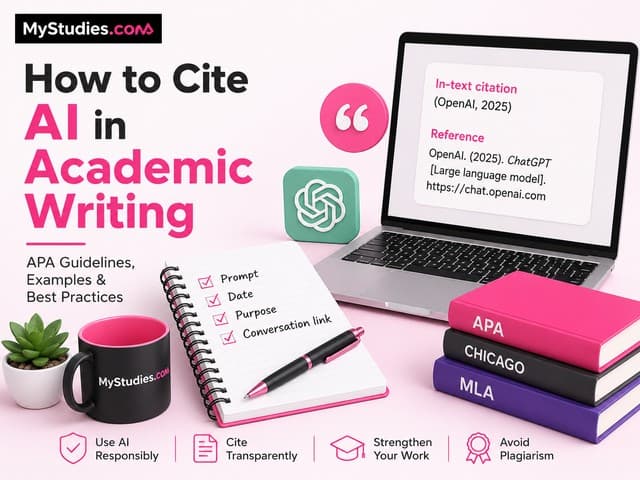
APA, Chicago, and other citation styles have not yet fully incorporated AI into their guidelines. Yet a student who uses AI without citing it when writing a dissertation or other academic paper could face serious academic penalties. So... How should you use AI and cite it properly in an academic paper?
One idea is becoming increasingly accepted: AI should be cited just like any other author whenever it is used to write a dissertation or any other academic or scientific document. This would require citing the software used, the date, the prompt, and sharing the conversation with the AI tool. That can be time-consuming. Let's simplify the process.
When Should You Cite AI?
AI can be used in many different ways, from searching for information like Google to generating entire documents. Depending on how it is used, the need for proper citation varies.
Using AI to Find Sources
When AI is used simply as a search engine, it does not need to be cited, just as we do not cite Google in a bibliography. Instead, you should consult the original sources and cite those sources directly. It is important not to blindly cite the references suggested by AI without checking them first, especially because AI models regularly hallucinate and may invent nonexistent or inaccurate references.
Helpful link: an AI writer that consults and includes sources
Using AI to Translate a Source
When conducting research, it is common to come across articles written in English or another language that you do not fully understand. In such cases, asking AI to translate the content can be helpful. However, pay close attention to the AI tool you use, its terms of service, and copyright compliance. Never upload private or copyrighted material to an AI platform that uses user data to train its models (and therefore claims rights over that content). In this situation, citing the AI is generally not necessary. Some students choose to mention the AI tool in the acknowledgments section, but this is not required.
Helpful link: an AI assistant that protects user data
Using AI for Inspiration
Many students use generative AI as a source of inspiration—for example, to create an outline or generate ideas to develop in their paper. If you incorporate ideas provided by AI into your work, it is best practice to acknowledge that use.
Helpful link: get help creating an original outline without AI
Copying or Paraphrasing AI-Generated Text
If you use any portion of text generated by AI in response to a prompt, whether copied directly or paraphrased, you should clearly indicate this. Before doing so, always verify the information to ensure you are not reproducing incorrect information or AI hallucinations.
Helpful link: affordable AI and plagiarism detector
Using AI to Proofread a Dissertation
Once again, be careful not to use an AI platform that will appropriate your writing to train its models, and avoid editing your dissertation so extensively with AI that it is detected as AI-generated. If AI was only used to proofread your document, citing it is generally unnecessary. As with translation, however, mentioning the tool in the acknowledgments section is becoming increasingly common.
Helpful link: have your dissertation proofread by a human, not AI
How to Cite AI in a Dissertation
Before anything else, make sure that using AI is allowed for the assignment in question. If it is prohibited, the answer is simple: do not use AI. Detection tools are becoming increasingly effective, and instructors are becoming better at recognizing AI-generated writing. AI-generated content often leaves recognizable patterns, especially when you know what to look for. If AI is not permitted, traditional search engines should be used for research, while online academic libraries can help you find examples, better understand assignment expectations, and expand your bibliography.
Helpful link: need help with a dissertation without AI?
Helpful link: the MyStudies online academic library
If AI use has been authorized, it should be cited in a way that allows readers to understand how the information was obtained.
Citing AI Within the Text
Every idea, piece of information, or paragraph generated by AI software should be clearly identifiable within the text. There are two simple ways to accomplish this:
- Include an in-text citation (OpenAI, 2025).
- Use a footnote to provide additional details, such as the prompt used and the date the AI was accessed.
Citing AI in the Bibliography
Several universities recommend documenting every use of artificial intelligence in a table. The first column should identify the AI tool used, followed by the prompt, the purpose of the AI-generated content, the page where it appears, and either a link to the AI conversation or the appendix where it is included. If your AI tool does not provide a shareable conversation link, you should copy and paste the conversation into an appendix. While not ideal, this is currently the only way for readers to verify the source.
Helpful link: an academic AI that provides a shareable citation link
For example:
| AI Tool | Prompt | Use | Link or Appendix |
| MyStudies AI | Summarize the meaning of Article 1 of the French Constitution | Summary copied, p. 5 | https://ai.mystudies.com/tools/chat/e3e78cd1-50f8-4727-9f45-7c14c0ac558e |
In short, transparency is essential. AI is becoming increasingly accepted in academic settings, but it should be used in a way that helps students think critically and genuinely understand their work. Properly citing AI in your dissertation is key to demonstrating responsible use and avoiding accusations of plagiarism.
Looking for an AI-Free Academic Writer?
Find one on MyStudiesMyStudies, the site that helps you revise
Instant revision notes, personalized quizzes, custom practice to help you ace high school exams, university finals, oral exams and presentations....